


At Snus Vikings, we have, as you might have noticed, a bit of an interest in Vikings and the New Year prompted a discussion in the office about the Vikings Calendar and how it actually worked. What we found while reading up on it was quite fascinating so we thought we'd share it with you.
The Vikings relationship to time was similar to ours but their calendar had certain fundamental changes that meant that the timing of the beats of the year was very different. There was no fixed New Year’s Day, no numbered years ticking forward in neat succession, and no rigid division into spring, summer, autumn and winter. Instead, time was measured in a way that reflected daily life, seasonal survival, and the natural rhythms of the sun and moon.
What we now call the Viking calendar was not a single, standardised system, but a shared approach to timekeeping across Scandinavia and Iceland during the Viking Age. While surviving sources are limited and often written down centuries later, a clear picture emerges: the Norse calendar was practical, seasonal, and deeply connected to nature.
A Year Split in Two
Rather than dividing the year into four seasons, the Vikings typically split the year into just two: winter and summer. These were not abstract concepts but functional halves of the year, defining what could be grown, travelled, hunted, traded, or endured.
The website Valkyrja.com created a lovely graphic showing how the Norse calendar interacted with the solstices and lunar phases
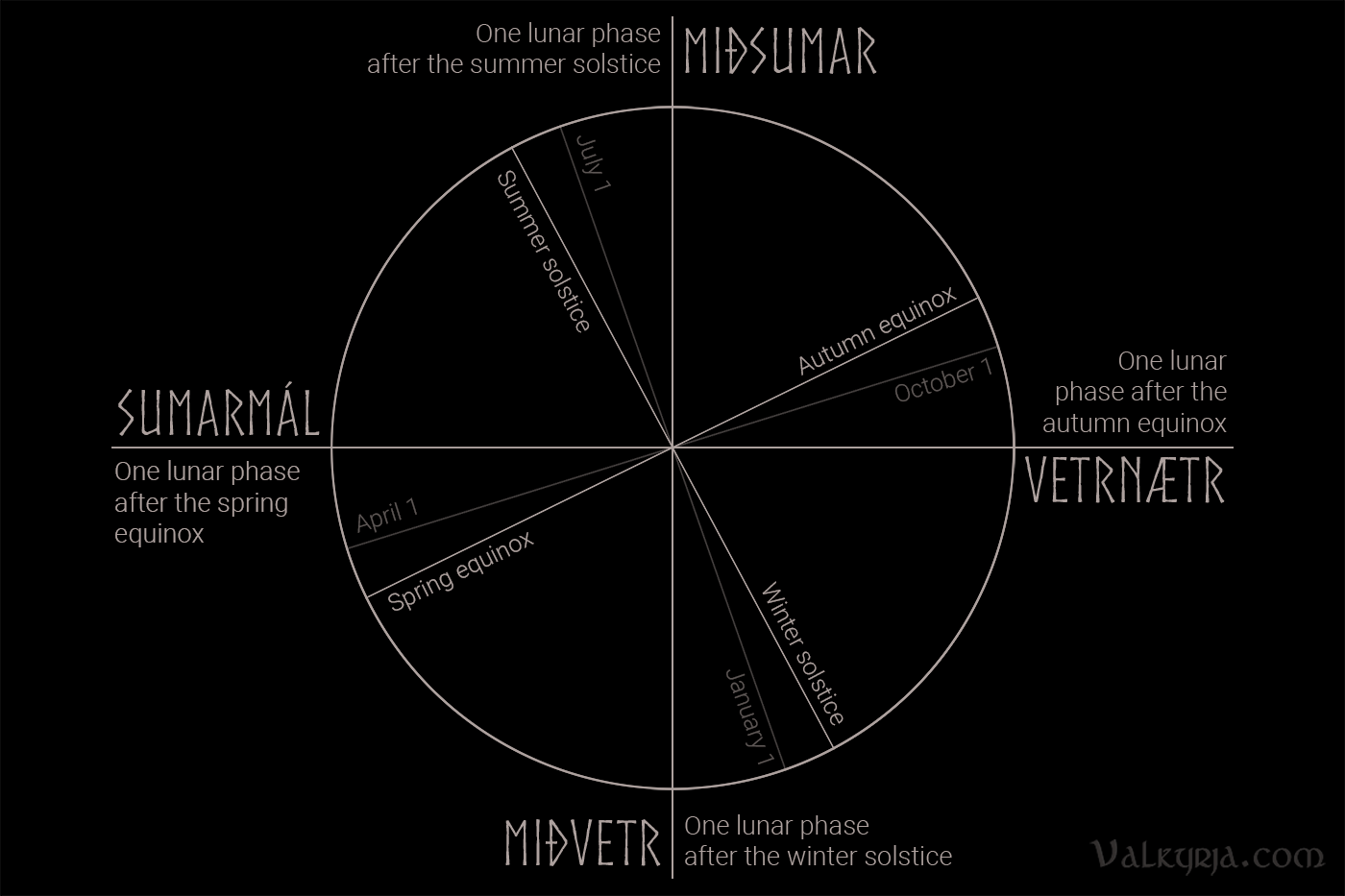
Age was often counted in winters rather than years, highlighting how central winter was to Norse life. This emphasis suggests that the transition into summer, rather than mid-winter, may have felt more like a true turning point in the year. In Icelandic tradition, the first day of summer was treated as a significant marker, a moment when the world became workable again.
Lunar Months, Solar Sense
The Norse calendar followed the moon. Months were counted from one new moon to the next, making them roughly 29 to 30 days long. Twelve lunar months, however, fall short of a full solar year by about eleven days. Left uncorrected, this would cause the calendar to drift steadily out of sync with the seasons.
In a region where seasonal timing was critical for farming and survival, this wasn’t an option. To prevent drift, the Norse used a lunisolar system, adding extra days or even an extra month when needed to realign the lunar calendar with the solar year. The winter solstice appears to have played a key role as a reference point for deciding when these adjustments were necessary.
The result was a calendar that followed the moon closely, but never lost sight of the sun.
The Norse Months and What They Tell Us
The names of the Norse months offer direct insight into Viking life. Many refer to food preparation, agricultural work, or seasonal conditions rather than abstract timekeeping.
Winter months
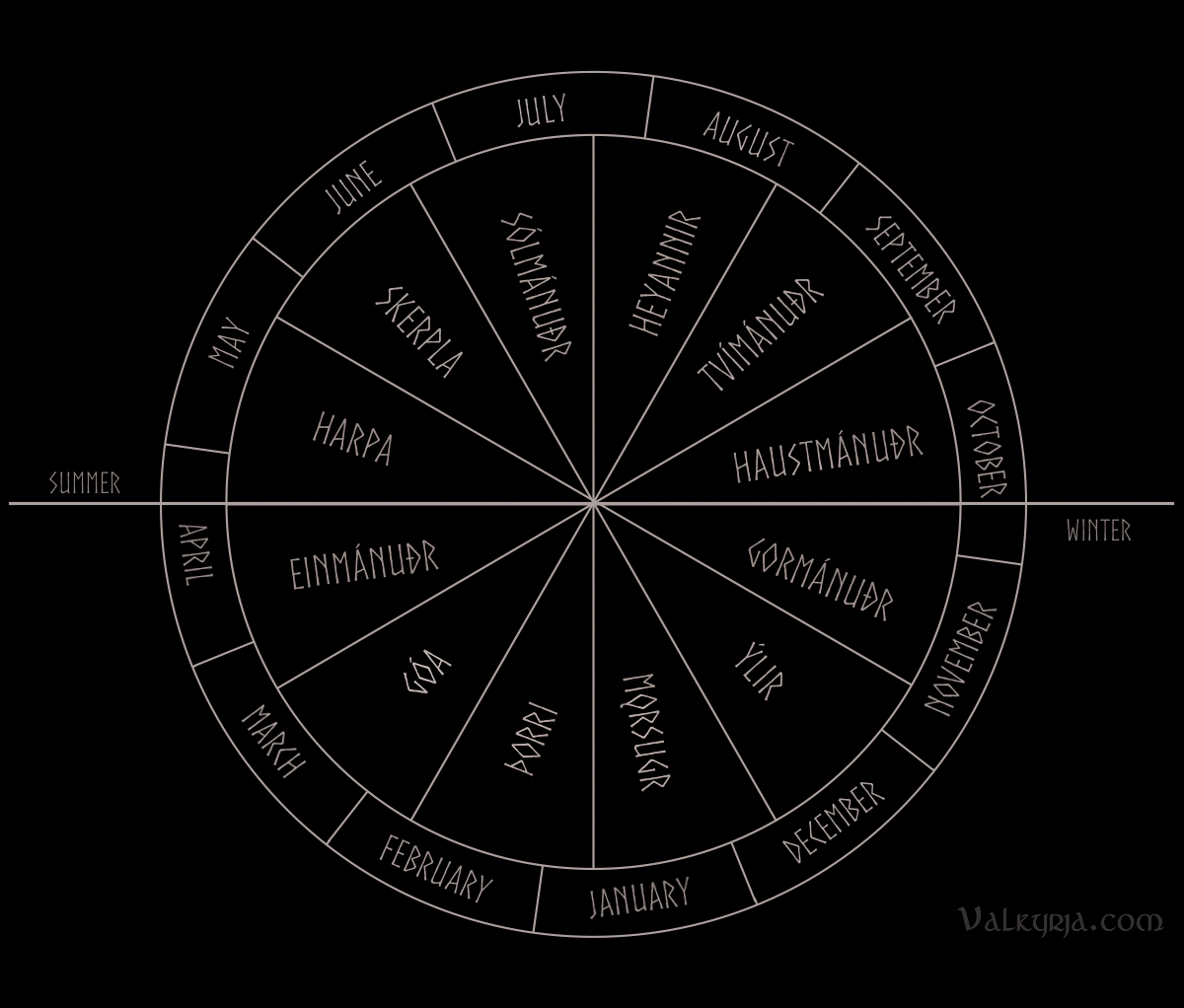
- Gormánuður (mid-October to mid-November): the slaughter month, when livestock was prepared for winter
- Ýlir (mid-November to mid-December): associated with Yule and midwinter traditions
- Mörsugur (mid-December to mid-January): linked to fat and marrow, essential winter nutrition
- Þorri (mid-January to mid-February): the heart of winter, still marked by Þorrablót in Iceland
- Gói (mid-February to mid-March): late winter, associated with fertility and renewal
- Einmánuður (mid-March to mid-April): the final month of winter
Summer months
- Harpa (mid-April to mid-May): the beginning of summer, still celebrated in Iceland today
- Skerpla (mid-May to mid-June): early summer, often marked by unpredictable weather
- Sólmánuður (mid-June to mid-July): the sun month, during the brightest part of the year
- Heyannir (mid-July to mid-August): haymaking time
- Tvímánuður (mid-August to mid-September): a reminder that summer is drawing to a close
- Haustmánuður (mid-September to mid-October): the autumn month, preparing for winter
Some years included a thirteenth “late month” to keep the calendar aligned, reinforcing the idea that the system was flexible rather than fixed.
Once again, we can thank Valkyrja who created another lovely graphic to explain how the Norse and Gregorian calendars interact
Days, Gods, and the Week
Many Norse weekday names still survive in modern English, quietly preserving Viking-era ideas about time.
Sunday and Monday honour the sun and moon. Tuesday is named for the war god Týr, Wednesday for Odin, Thursday for Thor, and Friday for Frigg or Freya. Saturday derives from the Old Norse term for bathing, reflecting practical routines rather than divine figures.
The fact that these names persist shows just how deeply Norse culture shaped everyday life, even long after the Viking Age ended.
Festivals and the Myth of Solstice Worship
It’s often assumed that Viking celebrations revolved around the solstices and equinoxes, but surviving evidence suggests something more nuanced. Seasonal festivals, or blóts, were tied to the agricultural year and lunar cycles rather than fixed astronomical dates.
Major celebrations marked the start of winter, midwinter, the beginning of summer, and midsummer. These events were movable, often aligned with full moons rather than exact solar events. The coldest and warmest parts of the year in Scandinavia do not neatly coincide with solstices, and the Norse calendar reflects that lived reality.
This challenges the modern idea that Norse culture was centred on solar worship. Instead, it was grounded in climate, food, and survival.
Mythology and Time
Norse mythology reinforces the importance of both sun and moon in timekeeping. The sun (Sól) and moon (Máni) were believed to travel across the sky in chariots, pursued by wolves destined to devour them at Ragnarök. Their movement was not just cosmic drama, but a way for people to count days, months, and years.
Old Norse poetry frequently references waxing and waning moons as measures of time, showing how deeply lunar cycles were woven into everyday understanding.
Why the Viking Calendar Still Resonates
Despite its complexity, the Viking calendar often feels more intuitive than modern systems. It reflects the reality that time is experienced differently depending on light, weather, and work. Winter drags. Summer rushes by. Certain moments feel like natural beginnings, even if the calendar insists otherwise.
The Norse approach reminds us that timekeeping doesn’t have to be rigid to be meaningful. It can adapt, shift, and respond to the world around it.
In a culture that still struggles with dark winters and endless summer evenings, it’s easy to see why this way of measuring time made sense and why it still does.


